Performance
How Website Speed Affects Landing Page Performance
How page speed affects user experience, conversions and Core Web Vitals, and how to improve it.
3 min read
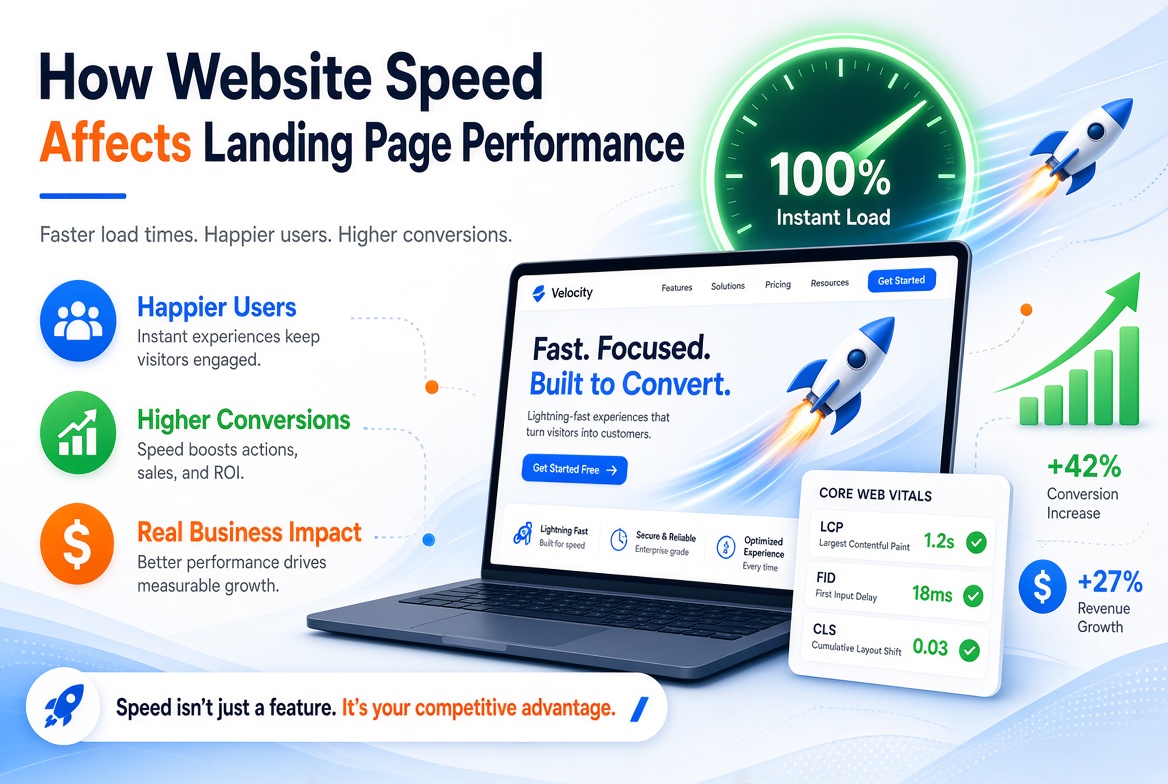
Your landing page might have a great design, compelling content and a strong offer. But if it takes too long to load, visitors may leave before they experience any of it.
Website speed is an important part of landing page development because it affects how quickly people can access your content and interact with your page.
For businesses that rely on enquiries, registrations or product sign-ups, performance should be considered from the beginning.
Why does landing page speed matter?
1. Visitors expect a usable experience
When someone clicks an advertisement or search result, they expect the destination page to load promptly.
Unnecessary delays can interrupt that experience and make visitors less likely to continue exploring.
2. Slow pages can create conversion friction
Imagine a potential customer trying to submit an enquiry form while the page is still loading scripts or displaying layout changes.
Performance problems can make the experience frustrating and create barriers to completing an action.
3. Performance is relevant to SEO
Google uses Core Web Vitals as part of its page experience assessment.
The main Core Web Vitals are:
- Largest Contentful Paint (LCP): Measures how quickly the main content appears.
- Interaction to Next Paint (INP): Measures responsiveness to user interactions.
- Cumulative Layout Shift (CLS): Measures unexpected visual movement.
These metrics help assess aspects of the user experience. Good scores do not guarantee higher rankings, but poor performance can indicate issues worth fixing.
What makes a landing page slow?
Common causes include:
Oversized images
Large image files can increase download time, especially on mobile connections.
Use appropriately sized images, modern formats such as WebP or AVIF where supported, and responsive image delivery.
Too much JavaScript
Unnecessary scripts and large frontend bundles can delay page rendering and interaction.
Only include the functionality your landing page actually needs.
Third-party scripts
Analytics, advertising pixels, chat widgets and embedded services can add loading and execution overhead.
Review which integrations are essential and load them responsibly.
Poorly implemented animations
Heavy animations and unnecessary effects can affect rendering and responsiveness.
Use animation selectively and respect reduced-motion preferences.
Unoptimised fonts
Large font files and unnecessary font weights can increase loading work.
Load only the font families and weights needed for your design.
How to improve landing page performance
A practical performance checklist includes:
- Optimise images and use appropriate dimensions.
- Reduce unnecessary JavaScript.
- Avoid loading non-essential third-party scripts.
- Use efficient fonts and font loading strategies.
- Reserve space for images and other visual elements.
- Lazy-load below-the-fold images where appropriate.
- Use caching and efficient asset delivery.
- Test the page using real-world performance tools.
Why I use Next.js and React for landing page development
Next.js and React provide a flexible foundation for building modern frontend experiences.
Next.js supports features such as static page generation, image optimisation and control over how content is delivered.
However, using a particular framework does not automatically make a website fast. Performance still depends on implementation choices, page assets, scripts and hosting configuration.
The objective is to use the technology appropriately rather than introduce complexity that doesn't benefit the project.
How do you check landing page performance?
Google PageSpeed Insights provides performance reports using both lab data and, where available, real-user field data.
You can use it to identify issues related to:
- Largest Contentful Paint.
- Interaction to Next Paint.
- Cumulative Layout Shift.
- Image delivery.
- JavaScript execution.
- Render-blocking resources.
Run tests on both mobile and desktop, and review the actual user experience rather than focusing on a single score.
Need a fast-loading landing page?
I develop custom landing pages with performance, responsive layouts and maintainable frontend implementation in mind.
If your existing landing page feels slow or you're preparing to launch a new one, get in touch to discuss your requirements.
Learn more about my landing page development service or see recent projects.