SEO
Does Your Landing Page Need SEO? A Practical Guide
Which SEO elements matter for a landing page, and how to make it easier for search engines to understand.
4 min read
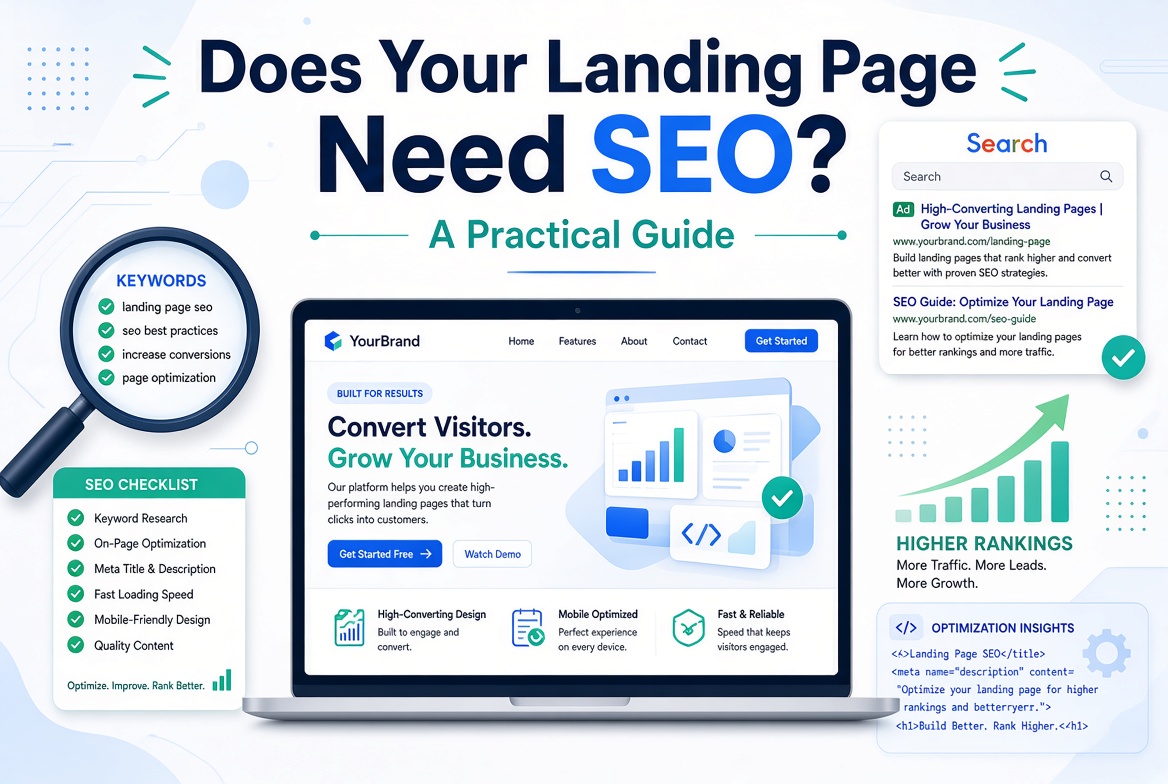
You've invested time in your business, prepared your offer and planned a landing page. But should you also think about search engine optimisation?
The answer depends on how you plan to attract visitors.
If your landing page is designed exclusively for a short-term advertising campaign, organic search may not be its main traffic source.
However, if you want potential customers to discover your business through Google, SEO should be considered during landing page development.
Here's what you need to know.
What is landing page SEO?
Landing page SEO is the process of making a landing page easier for search engines to discover, understand and potentially show for relevant searches.
It involves more than adding keywords.
A useful SEO-friendly landing page combines relevant content, clear structure, appropriate metadata, crawlability and a good user experience.
1. Target the right search intent
Before writing content, understand what your potential customers are searching for.
For example, someone searching for "landing page development services" may be looking to hire a developer.
Someone searching for "what is a landing page" is more likely looking for an explanation.
Your page should match the purpose behind the search.
Use relevant commercial phrases naturally in:
- Page title.
- Main heading.
- Supporting headings.
- Introductory copy.
- Relevant service descriptions.
- Internal links.
Avoid repeating keywords where they don't add value.
2. Write a descriptive page title and meta description
Your page title helps communicate the page topic to search engines and users.
For example:
Title: Freelance Landing Page Developer | Landing Page Development – Zafar Saleem
A useful meta description might be:
"Need a landing page for your startup or business? I build fast, responsive, SEO-friendly landing pages for SaaS companies, founders and small businesses."
Search engines may rewrite displayed snippets, so treat the meta description as a helpful summary rather than a guaranteed search result.
3. Use a clear heading structure
Your page should have one clear primary heading that describes its main purpose.
Organise supporting content with logical subheadings.
For a landing page development service, this might include:
- Landing page development services.
- What type of landing page do you need?
- How I develop your landing page.
- Recent landing page projects.
- Frequently asked questions.
Headings should help visitors understand the content rather than exist solely to contain keywords.
4. Create useful and relevant content
A landing page should explain:
- What you offer.
- Who your service is for.
- What problems you solve.
- What's included.
- How your process works.
- How potential customers can contact you.
Don't add long blocks of generic text just to make the page longer.
Focus on answering the questions that matter to your buyers.
5. Optimise images
Images can improve the presentation of your landing page, but they should be implemented carefully.
Use:
- Descriptive file names.
- Relevant alt text.
- Appropriate image dimensions.
- Modern image formats where suitable.
- Responsive image delivery.
Alt text should describe meaningful image content. Decorative images generally do not need descriptive alternative text.
6. Make sure search engines can access your page
Your landing page should be accessible to search engine crawlers.
Check:
- The page returns a successful response.
- Important content is available in the rendered HTML.
- The page isn't accidentally blocked by robots directives.
- Canonical URLs are configured correctly.
- Internal links are crawlable.
- Your sitemap includes the intended pages.
For a Next.js static website, make sure your generated pages and metadata are available in the exported output.
7. Improve page performance and mobile usability
Performance and usability are important parts of the overall page experience.
Optimise images, avoid unnecessary scripts, use responsive layouts and test the page across different screen sizes.
Google's Core Web Vitals can help identify performance issues affecting loading, responsiveness and visual stability.
8. Add relevant internal links
Internal links help visitors discover related content and help search engines understand how your pages are connected.
For example, an article about SaaS landing pages can link to your landing page development service.
A cost guide can link to your contact section.
Use descriptive anchor text that accurately explains the destination.
Does every landing page need SEO?
Not necessarily.
A dedicated advertising landing page may be designed primarily for visitors arriving from paid campaigns.
In that situation, conversion tracking, message consistency and campaign relevance may matter more than organic search visibility.
A service landing page intended to attract people searching Google should have SEO fundamentals built into its development.
The right approach depends on the page's purpose and traffic strategy.
Need an SEO-friendly landing page?
I develop custom landing pages with search-friendly structure, responsive layouts and performance in mind.
If you need a landing page for your startup, SaaS product or business, get in touch to discuss your requirements.
Learn more about my landing page development service or see recent projects.